The draft was about crypto mean reversion. It reported an information coefficient, a symbol count, and a short commit ID as a timestamp. It sounded responsible. When I checked the underlying workspace, its Git history was empty. There was no commit to inspect.
That invalidates the provenance claim. It does not prove the proposed analysis was wrong; it means the article cannot use chronology as evidence that the hypothesis preceded the analysis. I removed the claimed result instead of trying to make the old story sound more rigorous.
What Git does and does not prove
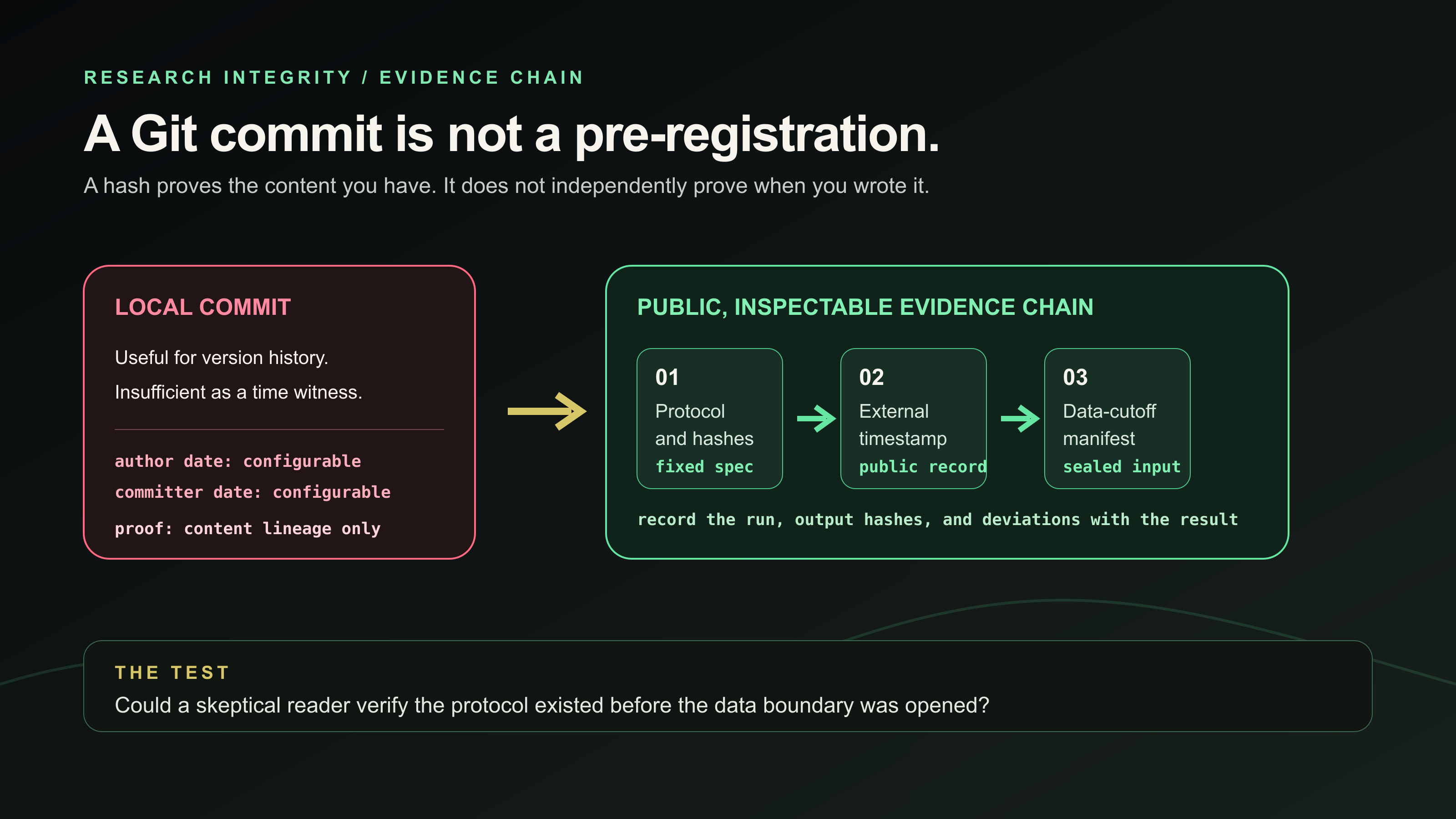
Git is excellent at recording content identity and ancestry. If two people have the same commit object, they can verify the tree, parent references, author identity fields, and commit message that created it. That is useful provenance.
It is a weaker claim than a trustworthy wall-clock timestamp. Git accepts author and committer dates from environment variables. The official Git documentationdescribes GIT_AUTHOR_DATE and GIT_COMMITTER_DATE as inputs to commit creation. A locally created commit can preserve a plausible chronology without independently establishing it.
# Both timestamps are metadata supplied when the commit is created.
GIT_AUTHOR_DATE="2024-01-01T00:00:00Z" \
GIT_COMMITTER_DATE="2024-01-01T00:00:00Z" \
git commit -m "protocol"

# The hash binds this content to those fields.
# It does not ask an outside clock whether the date was true.
For this kind of claim, Git tracks the protocol's content. The other records establish its chronology and relationship to the data.
What a defensible pre-registration has to show
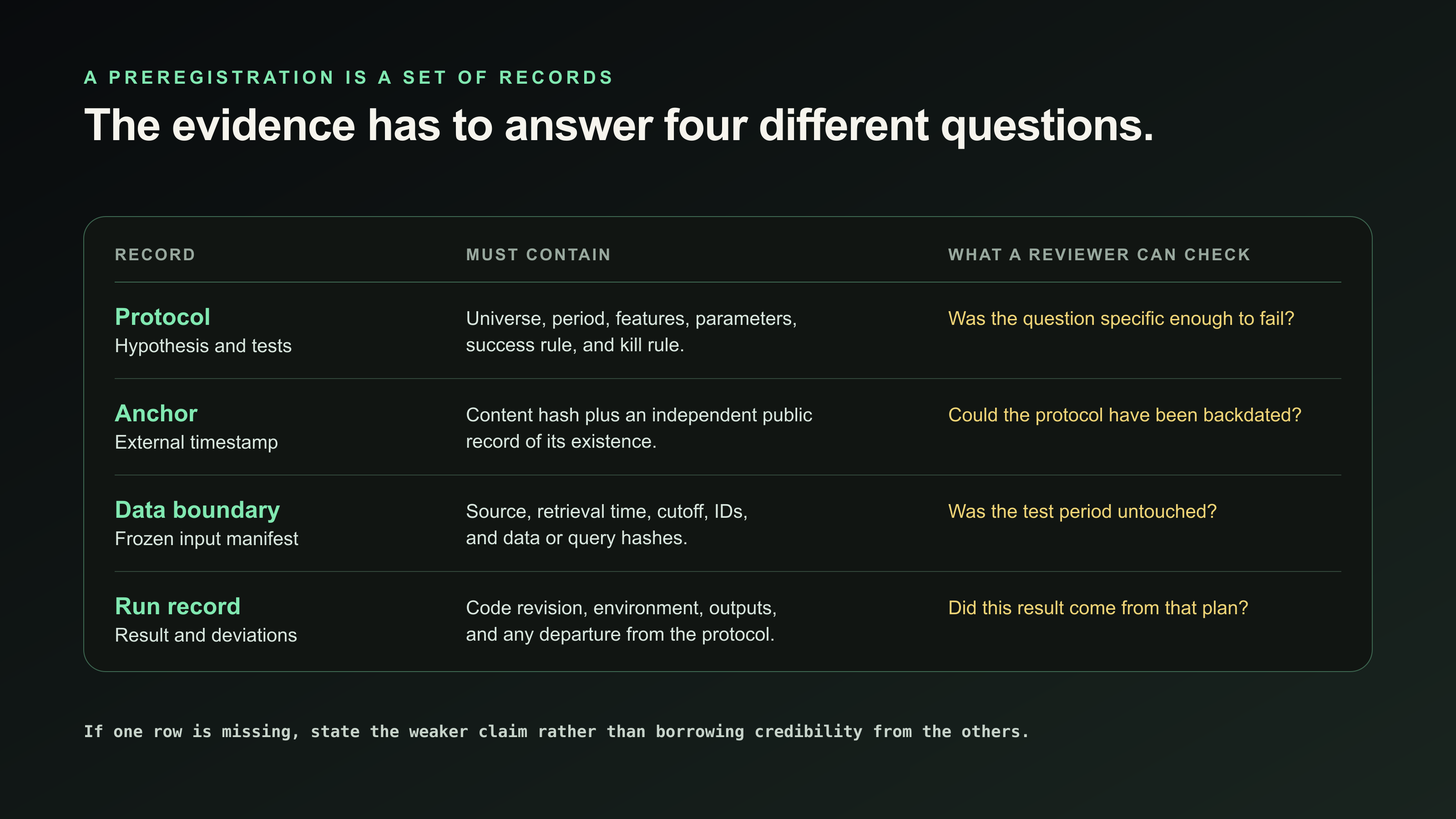
First, write a protocol that can lose. “Test mean reversion” is a research direction. It is not a pre-registered hypothesis. The protocol needs the universe, feature definition, data range, execution timing, parameters, primary statistic, success rule, and kill rule.
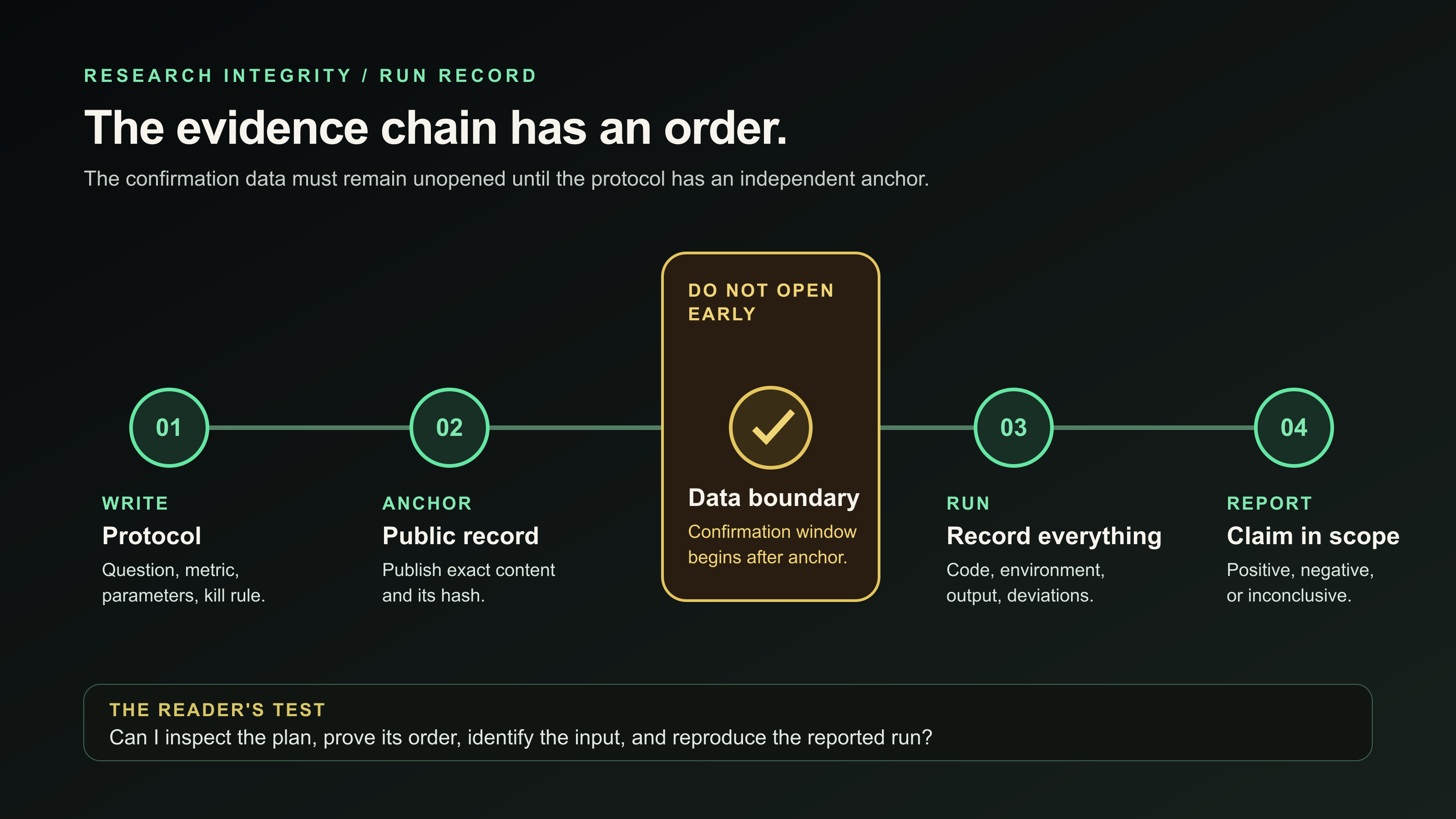
Second, anchor the exact protocol outside the researcher's machine. A public remote record, a signed release, an archival deposit, or a time-stamping service can create evidence another person can inspect. These mechanisms differ in strength.
Third, define the data boundary. A protocol written today cannot make a dataset “unseen” if the researcher already explored it. Record the source, retrieval time, time cutoff, instrument universe, and hashes or IDs of the input files or queries. The confirmation period must start after that boundary.
Finally, retain the run record: code revision, environment, raw output, derived metrics, and deviations. Without it, a reader cannot tell whether the reported result came from the frozen plan or a nearby variant.
A protocol should be machine-checkable
The prose is for the reviewer. A small manifest is for the runner and for future me. It makes omissions and parameter changes visible in a diff.
{
  "study_id": "cross-sectional-reversal-v1",
  "hypothesis": "A fixed reversal signal has positive net performance on the future window.",
  "data_boundary": {
    "source": "declared vendor and endpoint",
    "cutoff_utc": "2026-11-23T00:00:00Z",
    "universe_rule": "declared before retrieval",
    "input_manifest_sha256": "<computed after retrieval>"
  },
  "primary_test": {
    "metric": "net annualised Sharpe",
    "minimum": 0.4,
    "cost_model": "declared before the run"
  },
  "kill_rule": "fail if the primary test does not pass",
  "protocol_sha256": "<hash of this exact file>"
}
The placeholders show the boundary between the claim being fixed now and the evidence generated later. Filling a future hash or result before the run would defeat the point.
What public hosting adds
Publishing a protocol in a public repository gives collaborators and readers a place to inspect its contents. Signed commits and protected references make silent rewriting harder. GitHub documents bothprotected branchesand rules that can require signed commits or block force pushes.
These settings strengthen a workflow without turning GitHub into a scientific registry. State exactly which evidence was used: a public commit, a signed tag, an archive deposit, a third-party timestamp, or some combination. Readers can then judge the remaining trust assumptions.
What I can claim about the old study
The old draft has a written protocol and a proposed analysis path. Its materials contain no verified public pre-registration artifact, demonstrated untouched confirmation window, or evidence package from which a reader can reproduce the reported statistic. I therefore do not treat it as a confirmed finding or use it as support for a trading decision.
The next protocol needs a public anchor before its future data boundary opens. Its records should remain available whether the result is positive, negative, or empty.